Symmetry and topological characterization of quantum materials
An electron in a crystal spreads over atoms and bonds, and its wavefunction changes as it moves through the band. We connect this spatial structure to band topology and quantum geometry, then identify its signatures in tunnelling images, optical spectra, and electrical response. Our material models keep the orbital structure that makes those signatures possible.
Chemical bonds shape quantum geometry
The quantum geometry of the chemical bond (arXiv:2610.12746, 2026).
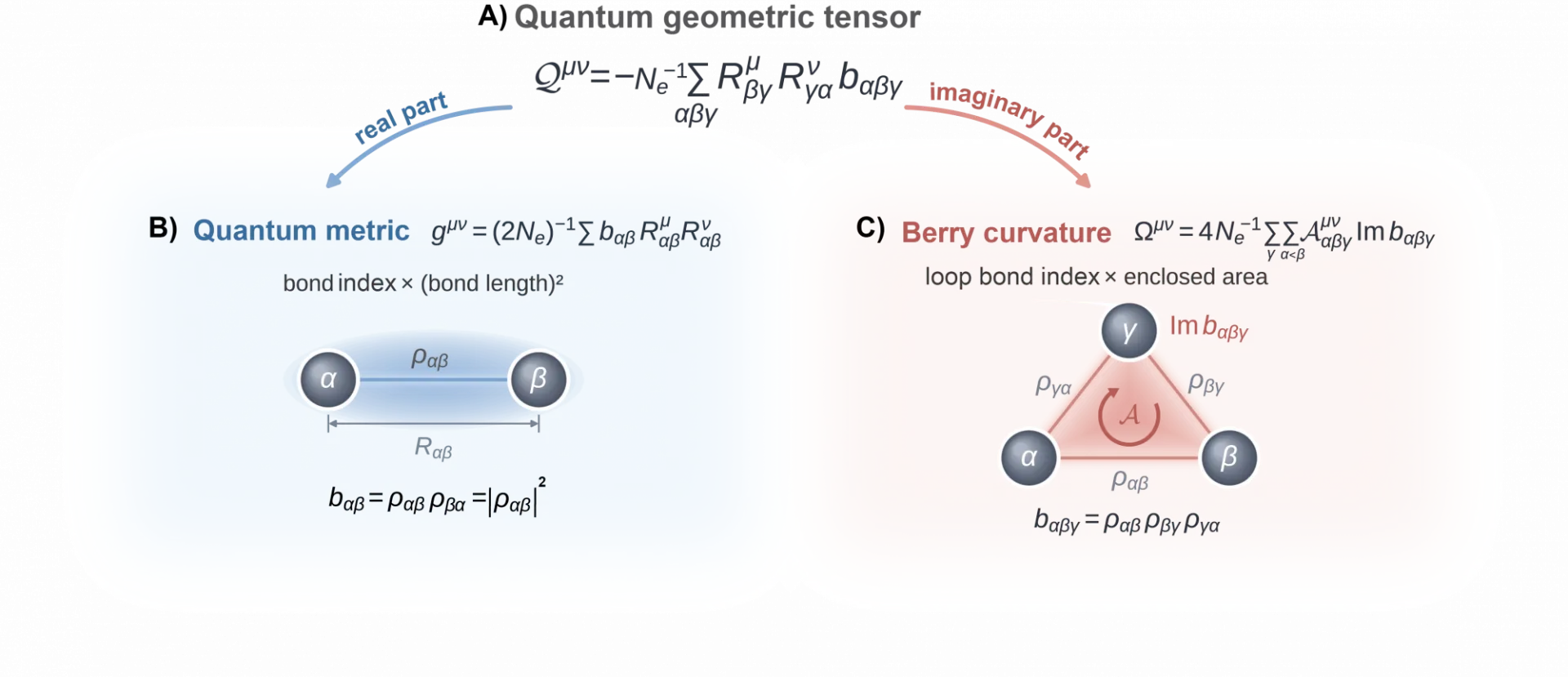
With Gabrielle Carrel, Fatmagül Katmer, and Leslie M. Schoop, Nish and Raquel connect chemical bonding indices to the quantum geometric tensor. Noncollinear three-center bonds provide a source of Berry curvature, while the energy spectrum of bond fluctuations connects bonding motifs to electromagnetic response.
Which local orbitals describe a band?
Cell Natural Orbitals in Quantum Materials
arXiv (2026).
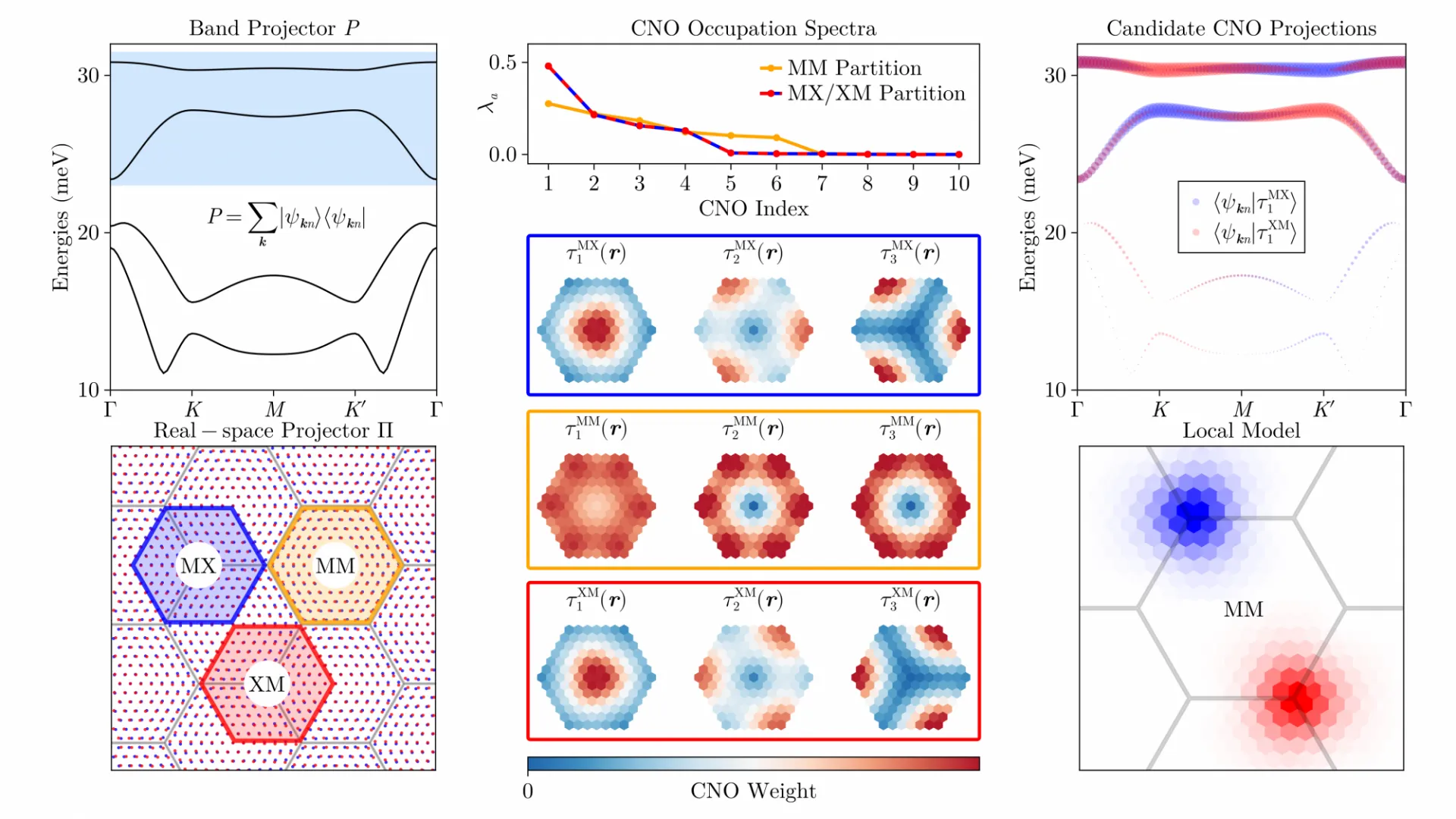
Harshitra, Nish, and Dani identify the local orbitals that carry the most weight in a chosen set of bands by restricting its band projector to one unit cell. These Cell Natural Orbitals preserve the local symmetry and expose how much orbital complexity the bands require. In twisted WSe₂, they provide trial orbitals for Wannier models that follow the changing charge density and band geometry across twist angle.
Topology in the places a wavefunction vanishes
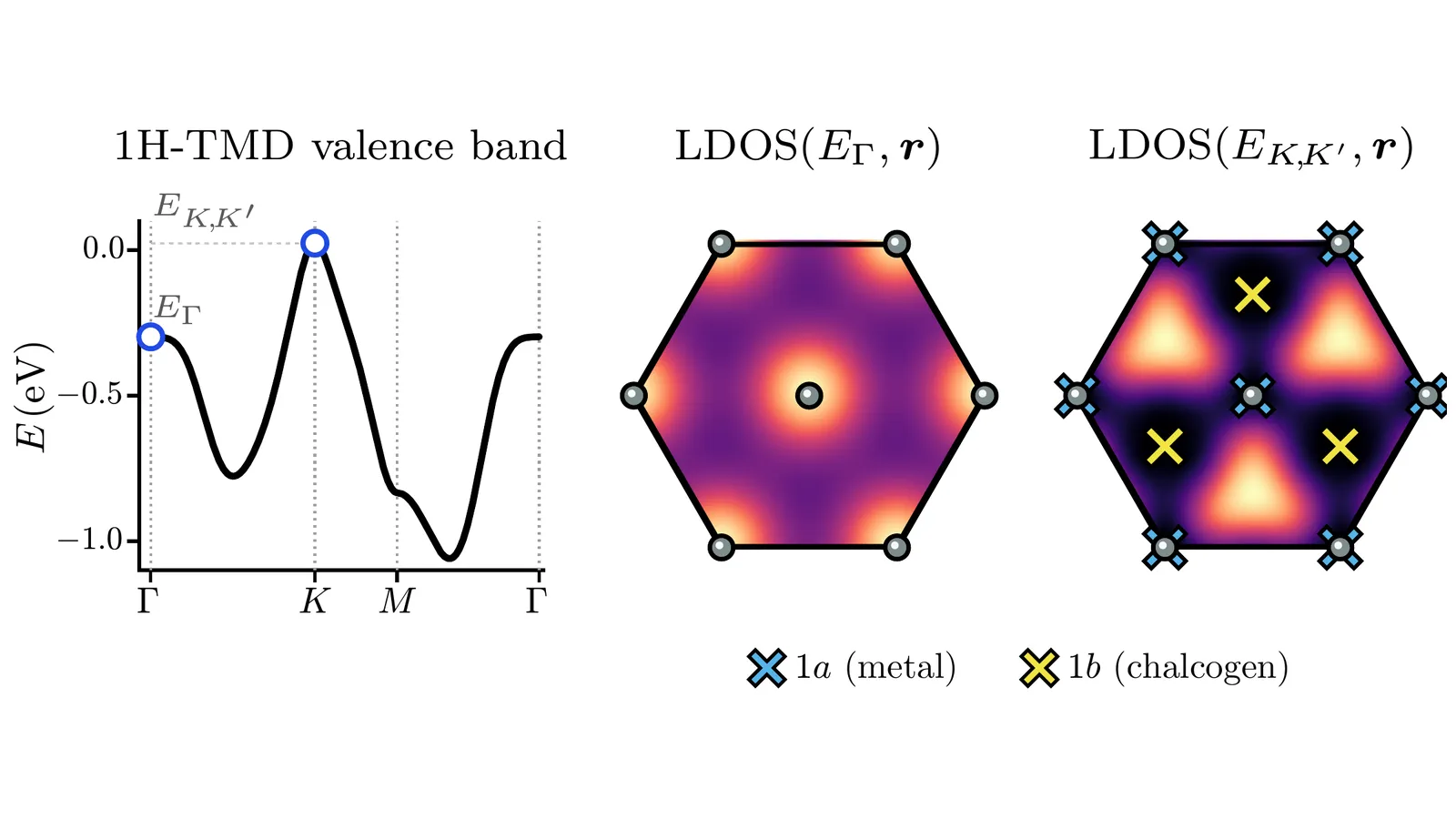
Real-Space Imaging of Band Topology via Wavefunction Zeros
arXiv (2026).
Julian and Raquel prove that crystal symmetry forces wavefunctions at special momenta to vanish at specific positions inside the unit cell. These zeros connect a real-space charge-density image to the symmetry representation of a band. The result explains the obstructed atomic limit of WSe₂ and provides topology diagnostics in Chern and time-reversal-invariant model systems.
Orbital motion sets measurable scales
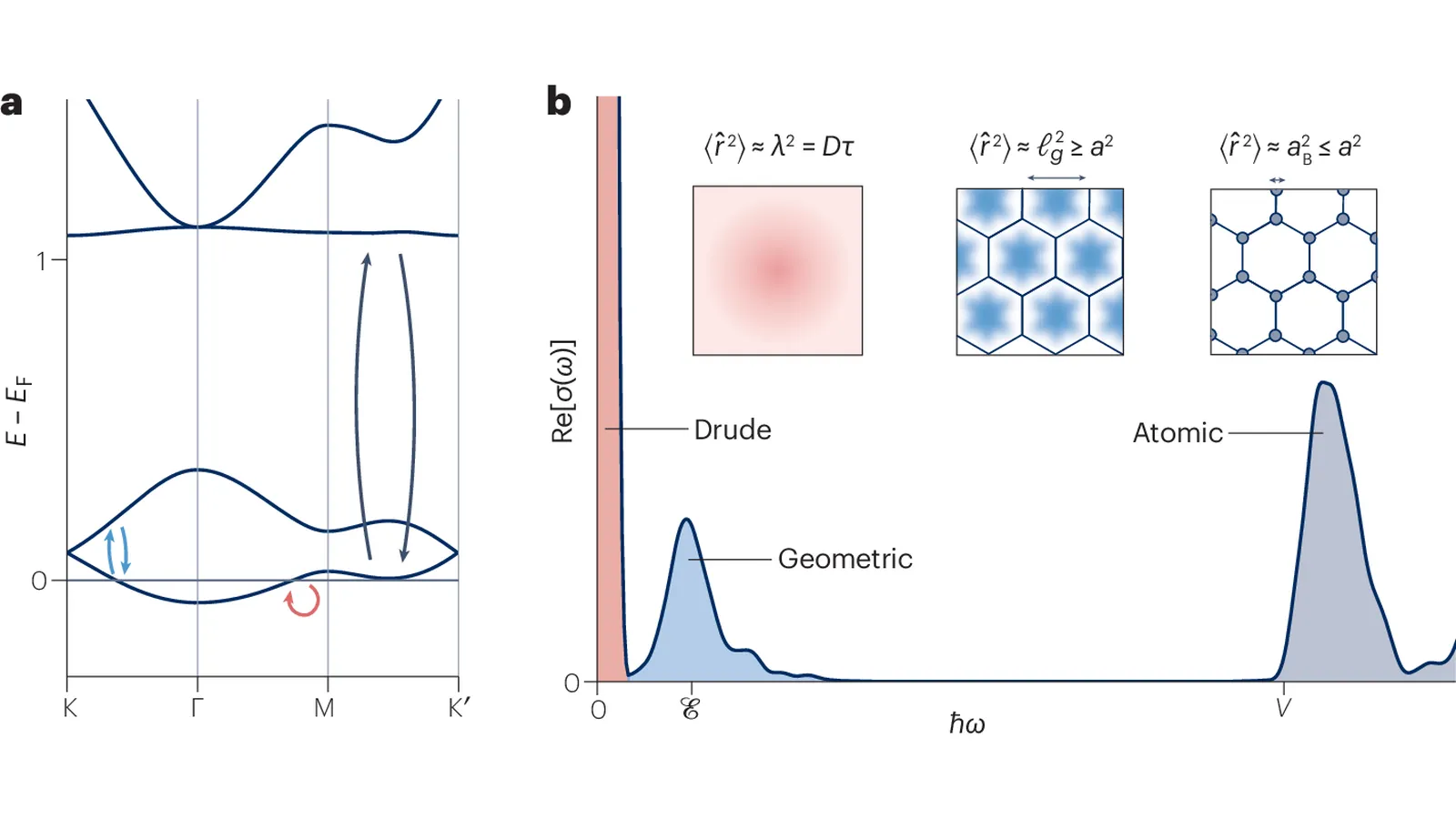
Quantum Geometry and the Hidden Scales in Materials
Nature Reviews Physics 8, 226–239 (2026).
Electrons can move within a unit cell even when a low-energy band appears almost flat. With Philip Moll and Tobias Holder, Nish and Raquel organize the resulting dipole fluctuations into length and time scales. The Perspective explains when those scales control optical, dielectric, and collective responses that band dispersion alone cannot describe.
Real-Space Imaging of the Band Topology of Transition Metal Dichalcogenides
Nature Physics 22, 680–685 (2026).
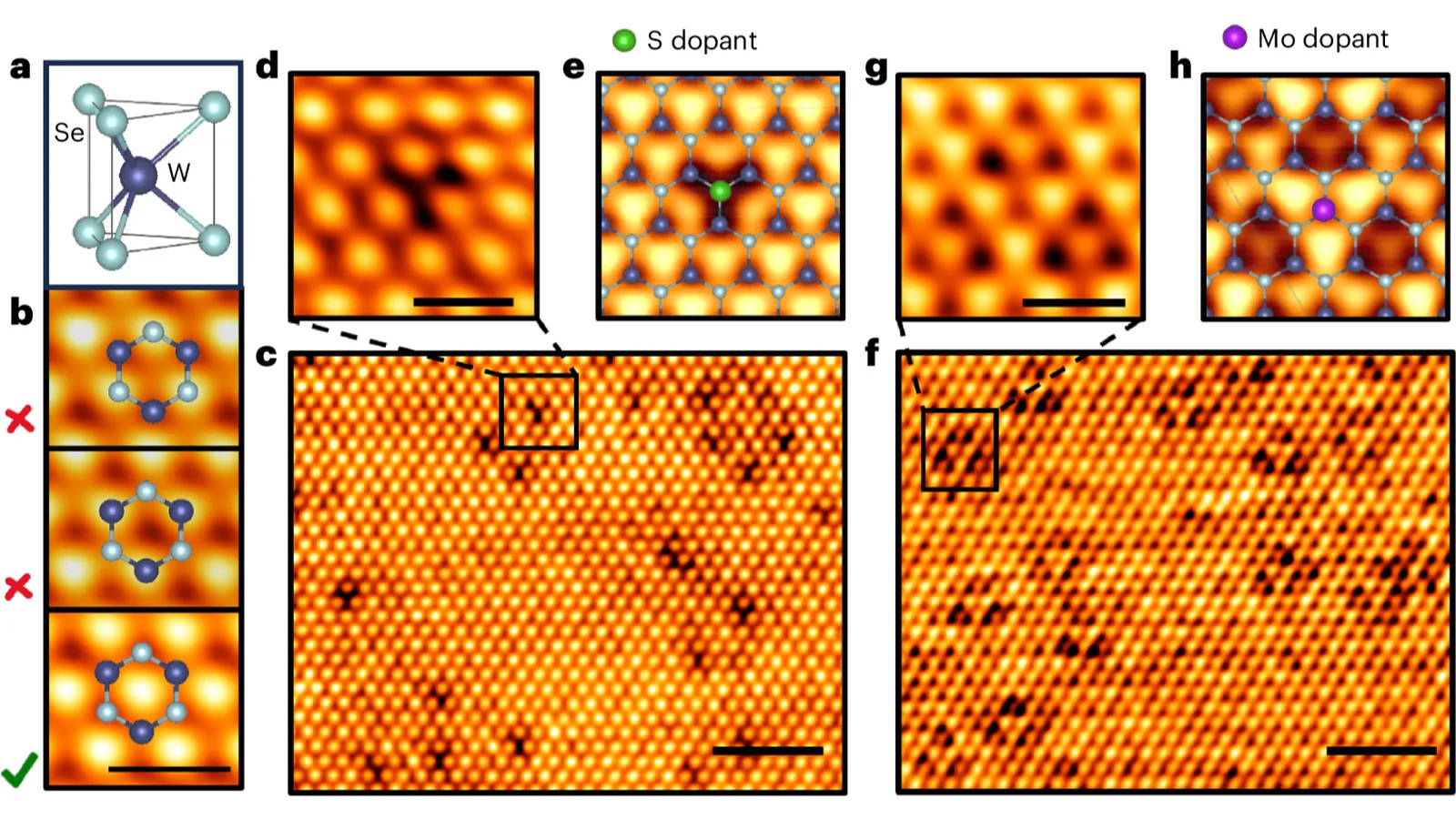
With the Pasupathy group and collaborators, we locate the valence-band Wannier centre of WSe₂ using atomically resolved tunnelling measurements. Site-specific dopants identify the atomic positions: the electronic density is largest on those sites at Γ, but between them at K. The contrast provides real-space evidence for an obstructed atomic insulator.
Frustrated electron hopping from the orbital configuration in a two-dimensional lattice
Nature Physics 21, 1260–1266 (2025).
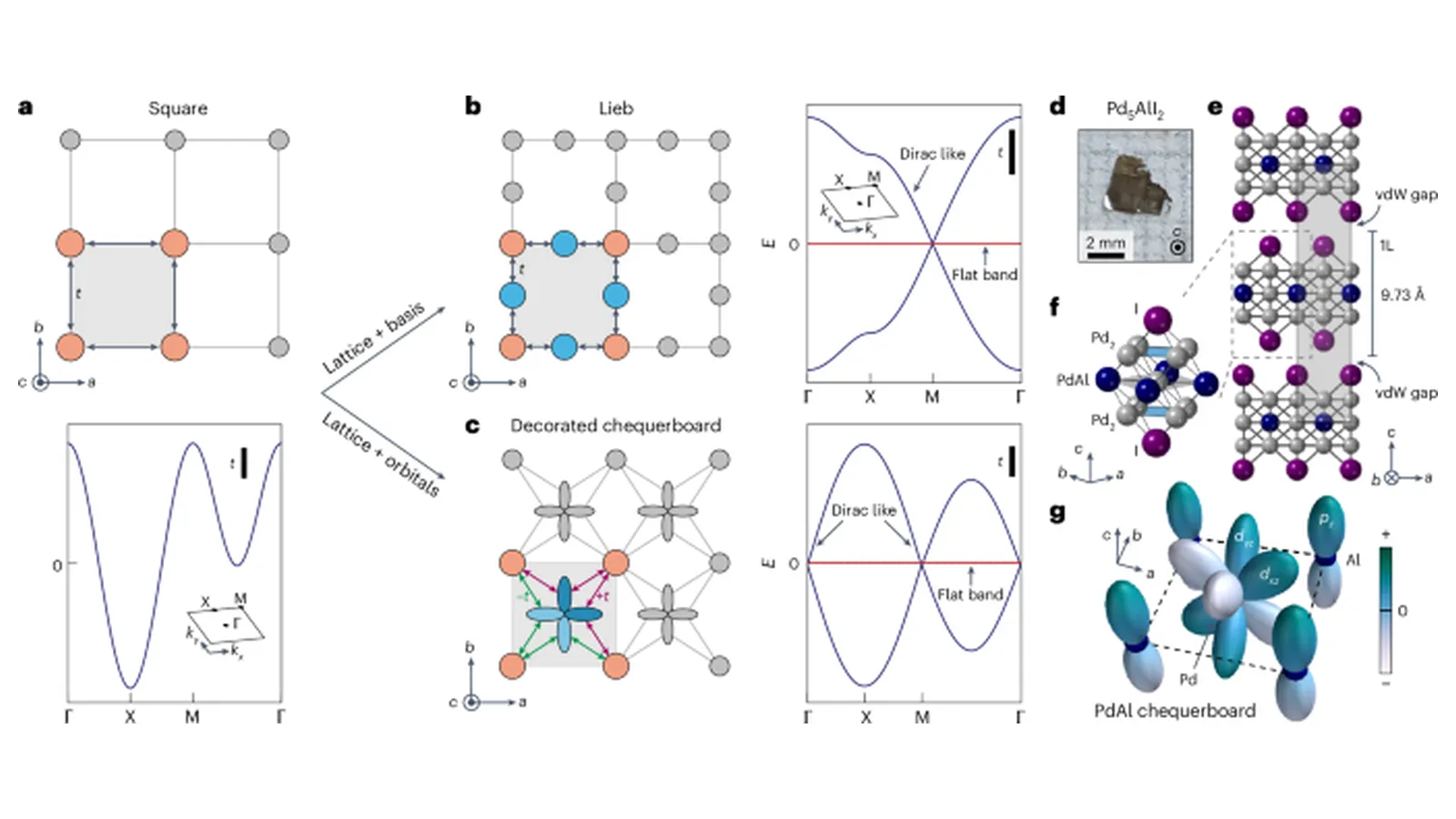
A square lattice can frustrate electron hopping through its orbital arrangement. With the Roy group and collaborators, we show this in Pd₅AlI₂, where photoemission and quantum oscillations reveal Dirac-like bands intersected by a locally flat band. The orbital structure produces the characteristic electronic dispersion of Lieb and dice lattices within a primitive square crystal lattice.
Instantaneous Response and Quantum Geometry of Insulators
Proceedings of the National Academy of Sciences 122, e2405837122 (2025).
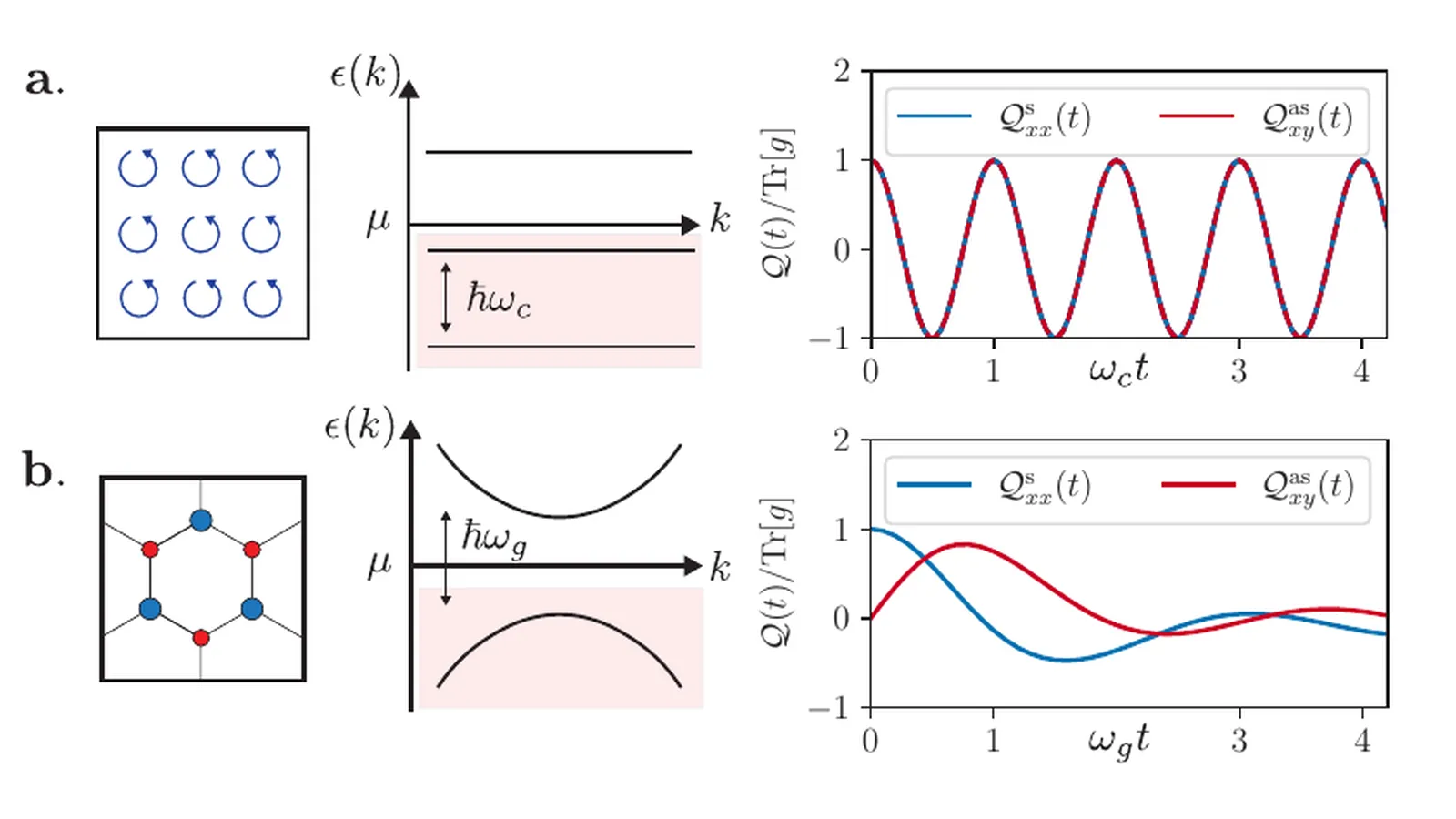
Bound electrons respond to an electric field through quantum dipole motion. Nish and Raquel describe this motion with a time-dependent quantum geometric tensor. Its time dependence organizes conductivity sum rules and connects localization, optical mass, orbital magnetic moment, and dielectric response within one gauge-invariant description.
Framework to Measure Quantum Metric from Step Response
Physical Review Letters 134, 106403 (2025).
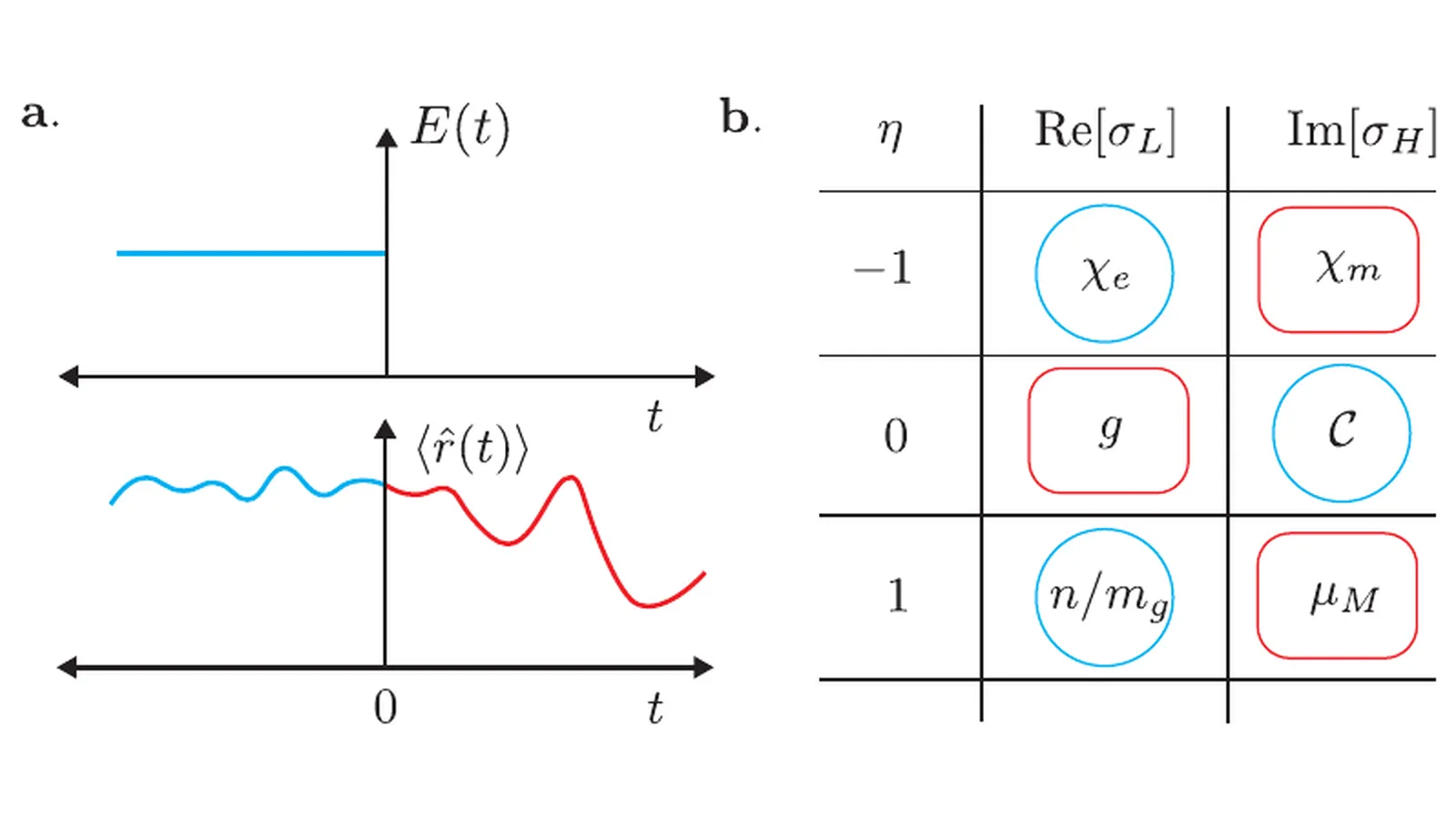
Ordinary conductivity mixes quantum geometry with excitation energies. Nish and Raquel propose a step-response protocol that separates them: prepare a constrained equilibrium state, release it, and measure the relaxation. The appropriately chosen field implements the frequency integral needed to extract the Brillouin-zone-integrated quantum metric.
Semi-Dirac Fermions in a Topological Metal
Physical Review X 14, 041057 (2024).
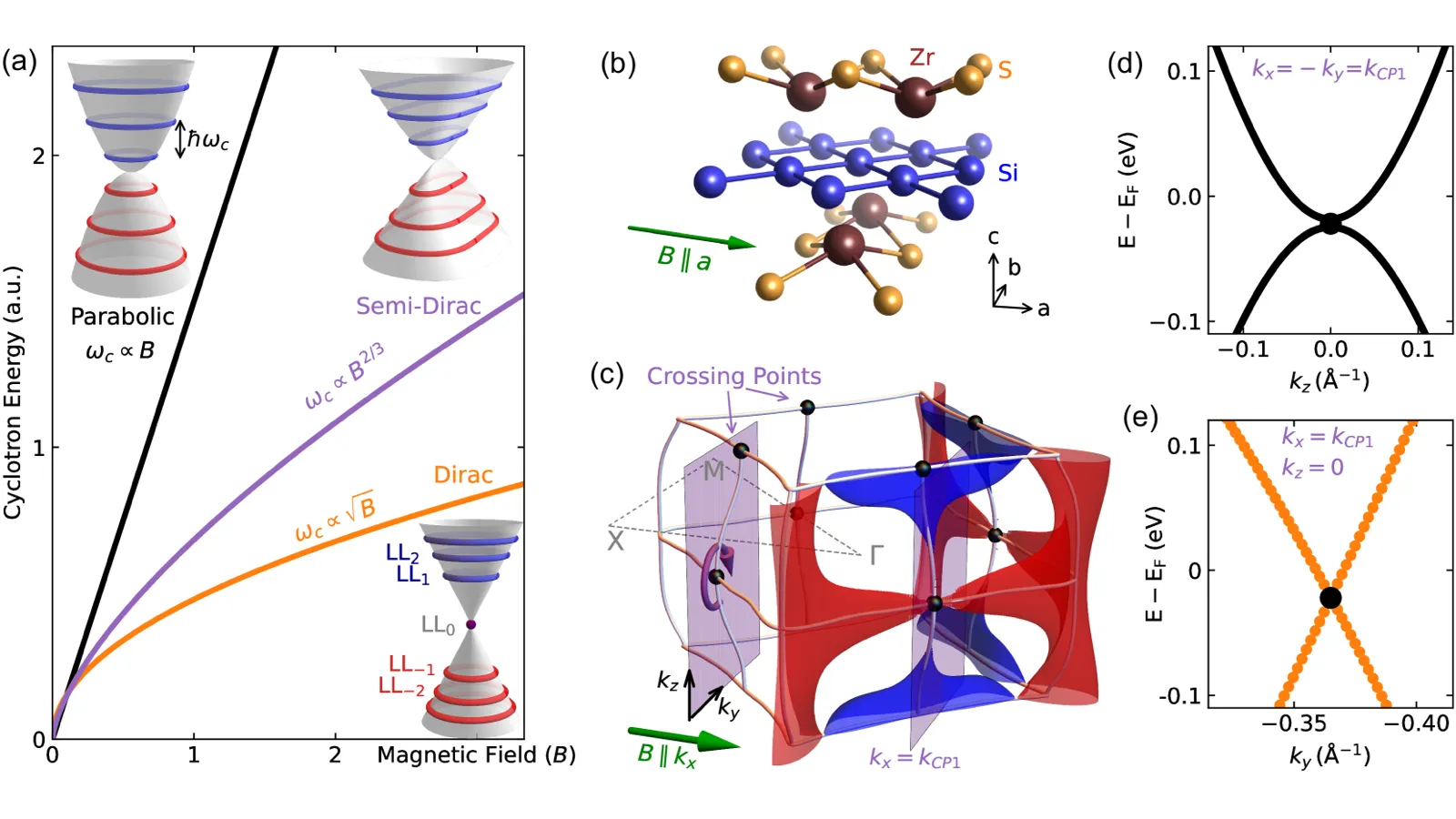
At a crossing of nodal lines, electrons can disperse linearly in one direction and quadratically in the other. With the Basov laboratory and collaborators, we identify these semi-Dirac excitations in ZrSiS through their characteristic magnetic-field dependence in optical spectra. Electronic-structure calculations and theory connect the signal to the nodal-line crossing.