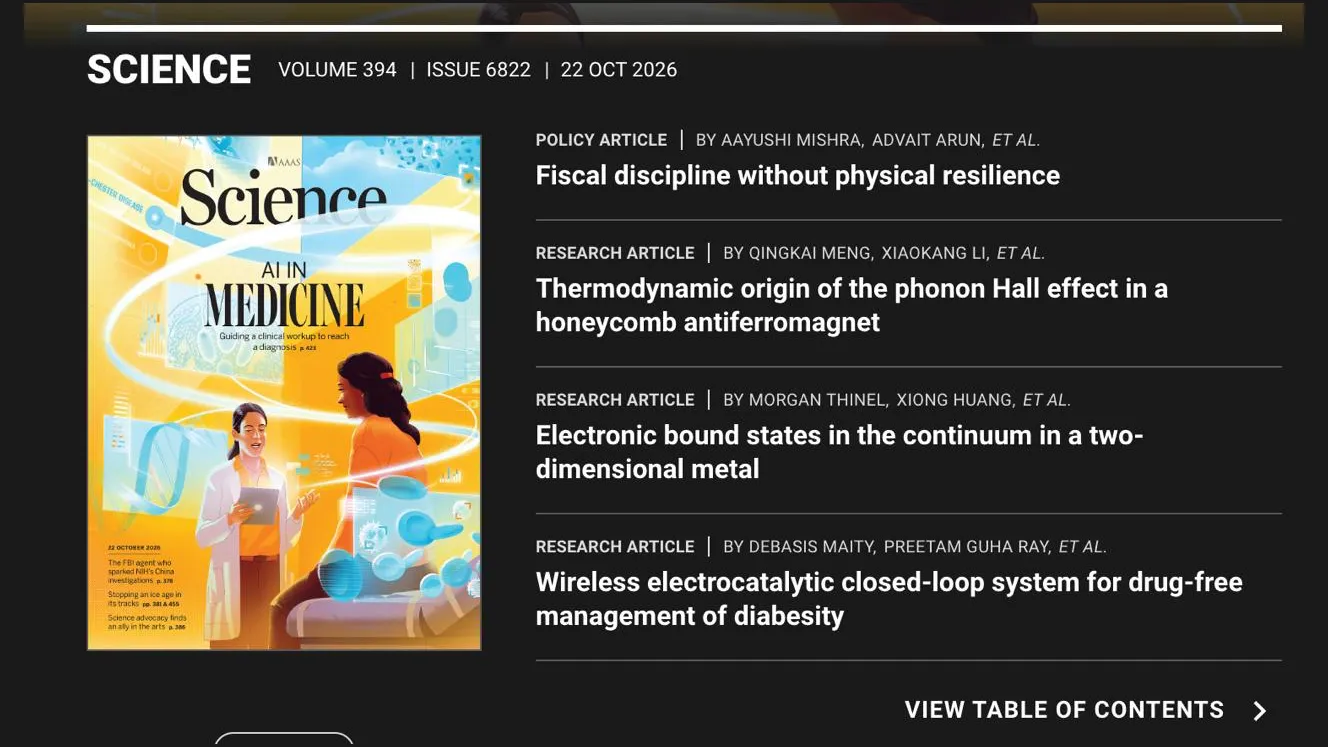
Electronic bound states in the continuum are now in Science!
Imagine dropping a droplet of oil in a pool: often it stays right there. But drop a little water into water, and soon you cannot tell which drop was yours. With electron waves in a metal, quantum mechanics offers a way to keep them trapped.
When an electron wave tries to leak out, it can take different paths. Their amplitudes can cancel through destructive quantum interference, keeping the wave localized around a defect even though the surrounding metal has states at the same energy. The crystal lattice determines which paths can cancel, giving us a recipe to look for other electronic bound states in the continuum.
i’m excited to see what we can do with these next!
This was such a fun project. Morgan Thinel did the experiments. A big thank you to my colleagues Abhay Pasupathy, Xavier Roy, Xiaoyang Zhu, Aravind Devarakonda, and Alexandru B. Georgescu for such good times exploring Pd₅AlI₂. Also a shoutout to my undergraduate collaborator Sebastian Rossi, who played a big role in finding the mathematically allowed trapped states.
Ellen Neff’s Columbia Quantum Initiative feature tells the story behind the work.
Read the paper: Morgan Thinel et al., Electronic bound states in the continuum in a two-dimensional metal, Science (2026).